
Skip to content
Crane Ops

Devlog

What's changed in Crane Ops, newest first. It moves quickly at the moment, so most days get an entry.

The LTM 1750 builds a tower at the wind farm

A new job at Cold Spring Ridge. The LTM 1750 drives up the ridge road, sets up on the pad and lifts 204 t of counterweight off nine trucks onto its own deck. Then the boom runs out, the Y-guy goes up, a luffing jib is pinned on, and it stands the turbine tower section by section to 76 m, with the LTM 1230 holding the bottom of each one.
Boom out, Y-guy up, luffing jib on. Recorded in the game.

The Crane Ops TC-90

The 90 t truck crane is now our own design: the Crane Ops TC-90, with its own look and its own load chart. It still does the steel job on Water Street.

Three new cranes in the menus

The LTM 1750-9.1 with its Y-guy and luffing jib, the LTM 11200-9.1 and its 100 m telescopic boom, and the LTR 1220, a telescopic crawler that walks with the load on the hook and changes its track width.

Also new: Realistic and Assisted physics modes, hook cameras you can resize and zoom, leaning your head out of the cab, and two-joystick support with the fast hoist on the trigger.

Driving that feels heavy

Every wheeled crane got a road test. They keep the speeds from their data sheets, but now they carry their weight: longer braking, slower steering at speed, a proper hill start and a chase camera that hangs back.

Tanner Knob and a tower crane put up by a crane

Tanner Knob is a cell site on a wooded hilltop: a 48 m lattice tower in sixteen picks, then the antenna platform and the dish.

And day one on the high-rise: the LTM 1230 puts the 340 EC-B flat-top tower crane up off eight trucks. Mast sections, the top unit, the counter-jib, the jib in seven sections, then the counterweight blocks.

The C500 boom truck

An all-black 60 US t boom truck for the small jobs in tight spots. It drives in off the street, sets its outriggers in whatever gap it gets, and works the Water Street roof.

Spreader bars

Modular spreader bars in four sizes, from 12 t to 110 t, rigged as a real stiff bar in the sling system. Eleven loads now go up on one.

Pile driving at Harbourside

The LR 1300 pitches the pile, sets it in the gate and drives it with the hammer. Since then: splicing on a second length, cutting off to level, a boulder that needs the chisel, a sheet pile wall on the vibro, and a night shift with a noise permit.

The career, rebuilt

Contracts come in more kinds now: standard jobs, night shifts, rush jobs, call-outs, tenders where you name your price, projects of three to six lifts against a deadline, and the big one-off jobs: the warehouse steel, the Mill Road girders, the tower crane, the refinery column and turbine T-12.

Clients keep a star rating on you. Cranes wear, need servicing, and can be sold or bought on finance. A new career starts with naming the company and picking its paint, then a first contract with the site supervisor talking you through it.

New kinds of lift

Removals, where the old unit is still bolted down: take its weight and hold it while the crew undo the bolts. Blind lifts, with nothing but the cab view and the banksman. Barge lifts off the Harbourside quay, with the deck moving under the load. And tandem lifts: a precast girder with your crane on one end and a second crane on the other, keeping it square and level.

Kellerman Tower

The seventh site. A flat-top tower crane on a twelve-storey building downtown comes down piece by piece onto a closed avenue. Every piece is pinned in, so you hook on, take its weight and hold it there while the fitters pull the pins. Progress saves after each lift.

Paint shop

Every crane can be repainted. Start from one of a handful of made-up fleet liveries, then change the body, boom, counterweight and cab colours, add stripes, a logo (one of the built-in ones or your own image file) and your company name.

Overturns play out now

A crawler that went over used to freeze the moment its boom touched the ground. Now the boom buckles at its joints, the machine rolls onto its side or drops back onto its tracks, the mast gets dragged over, the top counterweight slabs come off, and there's dust.

47.8 t on the hook, limiter off, booming down.

Water Street: frame, roof, and the building next door

A steel warehouse bay on a tight downtown lot, picked straight off the trucks as they pull in. Nineteen pieces of frame, then a roof of seventeen more, then the sister building next door, starting with its slab poured by bucket.

The frame and the roof can each be done with any of four cranes: the truck crane, the rough-terrain or either all-terrain.

Turbine T-12 is one mission

The wind farm used to be eleven separate jobs. It's one mission now, from the base section to the third blade, and it saves after every lift so you can stop and carry on another day.

Frame rate

A performance pass aimed at 120 fps. On the test PC (an RTX 4060) every map now runs at 138 fps or more at 1080p on High.

Ropes that behave like rope

The hoist line and the slings are simulated cables now. They stretch under load, go slack when you set down, catch on edges, and chains swing link by link. The load really hangs from them, so its weight shows up in each leg.

Wind, rebuilt

Turbulence and proper gusts. A load catches the wind on whichever face it shows and starts to turn; the tagline crew can hold it up to a point and then they let go. Each load gets its own wind limit, worked out the way EN 13000 does it, and past it the site supervisor calls a wind hold.

Lift planner, training course, and a 50 t all-terrain

Contracts now go through a lift plan with a Calculate button (chart, reach, ground bearing, wind, clearance along the slew), then mobilising, set-up, the lift, the supervisor's sign-off and an invoice.

There's a training course: eleven lessons, starting with a first lift that takes about five minutes.

And a new crane, the smallest so far: a 50 t, three-axle all-terrain.

Bayport Refinery and Mill Road Overpass

Two new sites. The refinery has exchangers, pumps, a crew basket and a 48 m column stood up with a tailing crane. The overpass has two precast girders to land on their bearings over live traffic.

The towns got working traffic lights, cars that stop at them and people on the crossings. And the rough-terrain crane went in.

Rain on the glass

Rain beads and runs on the cab glass, the wipers actually clear it, and then it comes back. Puddles fill in a downpour, and squalls bring lightning.

The art pass

Lighting, materials, ground and clutter, all reworked in one go. The rule: nothing on a site should look like it was put there for the player. A job was going on before you turned up.

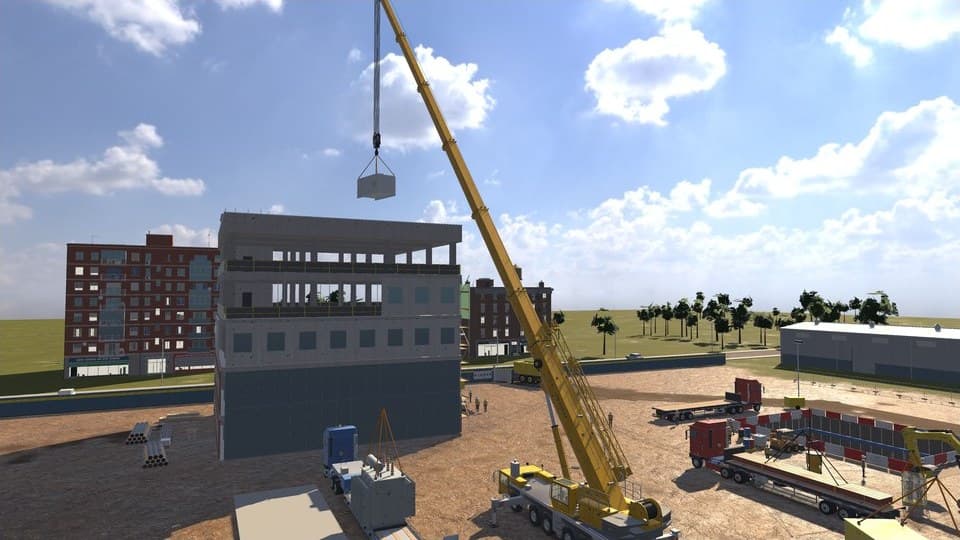
The rooftop lift at Riverside, after
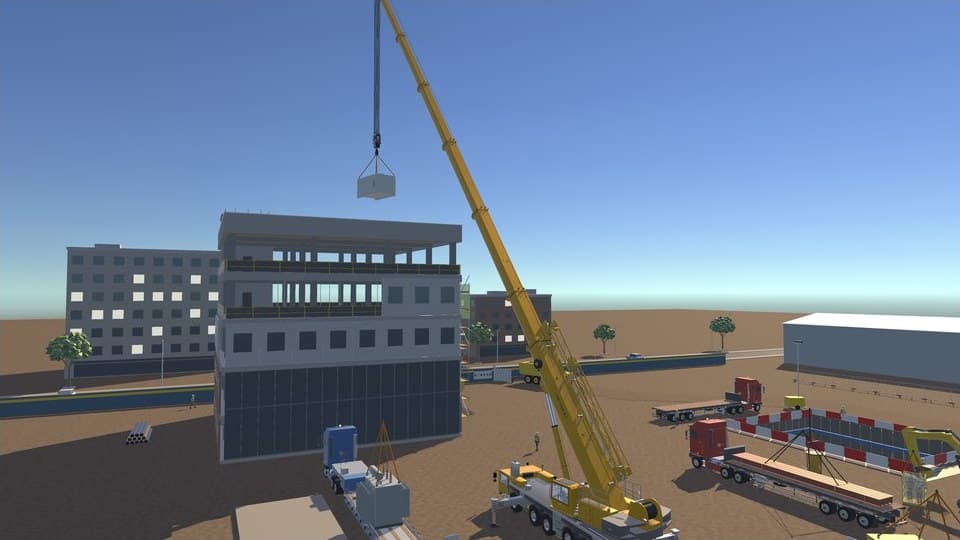
The rooftop lift at Riverside, before
BeforeAfter

Same shot, same camera. Drag across to compare.

Weather, and the first wind farm

Weather changes during a job now: squalls, fog and showers, with the site supervisor stopping work when the wind gets up.

And the first version of Cold Spring Ridge: a wooded ridge, a 110 m tower, the 700 t crawler on a luffing jib, and the 230 t all-terrain tailing each section.

That's as far back as this log goes.